Shaping the Future of the Valparaíso Region in Chile: Tackling Region-Wide Real-World Challenges Through Experiential Learning
Inside the Wicked Labs Chile Experiential Learning Program
As part of the Global Experience Week Wicked Labs Bootcamp, 80 MBA students from Imperial Business School travelled to Chile to tackle ten complex challenges shaping the present and future of the Valparaíso Region. Instead of working from simulations or historical case studies, students engaged directly with local partners across government, industry, and civil society to navigate challenges that are still unfolding.
In the specialised literature, these are known as wicked problems—systemic challenges characterized by multiple stakeholders, conflicting objectives, deep uncertainty, and no single optimal solution. This programme did not aim to neatly "solve" these issues, but to reframe systemic dynamics, ideate solutions, test interventions, and generate actionable insights and pathways for long-term change.
A Living Laboratory for Wicked Problem-Solving & Leadership
Why Valparaíso City-Port and the Valparaiso (Coastal) Region? The Case for Place-Based MBA Learning
Valparaíso is a historical City-Port embedded in a Central Region (of the same name) of Chile, a long, exciting and remote country along the Pacific Coast of South America. This is a region where economic development, environmental stewardship, and cultural preservation intersect daily. Yet, there is also decline, infrastructure fragility and fragmented governance. Students engaged directly with local residents, academics, policymakers, local university students, architects, city planners, and fishermen to gather information, conduct field interviews, understand the problem first-hand, and build a bigger picture using systems thinking, design-led innovation, and entrepreneurial experimentation. All of the above in 1 week.
Their work centered on interconnected issues across four core tracks:
Mega-Wildfire Reconstruction & Housing: Examining the complex financing, regulatory hurdles, and governance bottlenecks involved in rebuilding housing and infrastructure following the Viña del Mar city wildfires. Imperial teams mapped different stakeholder needs and desires to accelerate recovery while strengthening community resilience.
Preserving Urban Heritage: Addressing the fragmented operational, business, and administrative responsibilities of Valparaíso's historic funiculars. Students evaluated sustainable funding, tourism integration, and preservation strategies to restore lost mobility capacity while protecting an iconic cultural and community asset.
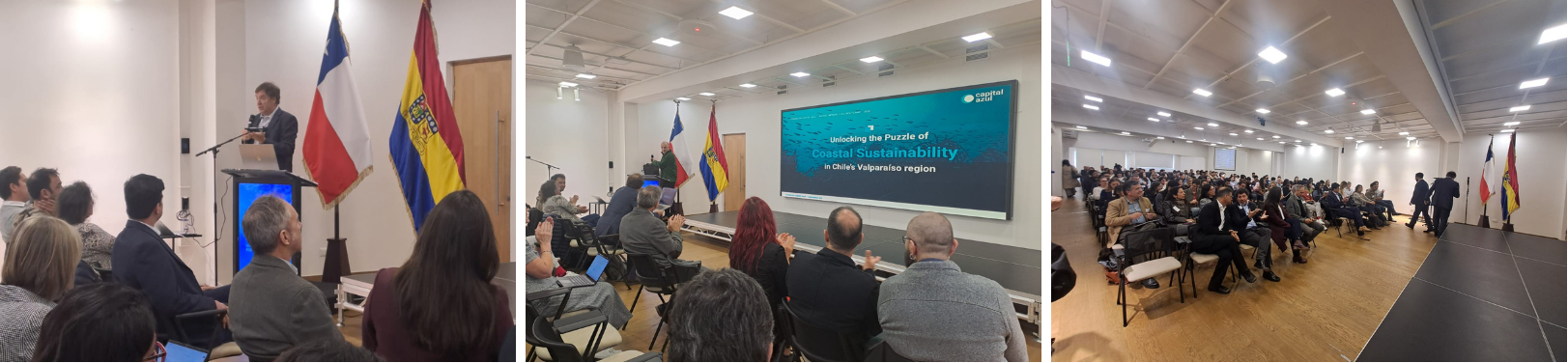
The Blue Economy & Marine Protected Areas: Partnering with NGO Capital Azul to explore how community-led ocean protection in coastal reserves intersects with governance complexity, innovative financing, and regional networks to support local fishing communities.
Urban & Industrial Transformation: Collaborating with the Port of Valparaiso to reimagine assets like Muelle (Pier) Barón and the former Simón Bolívar Warehouse, balancing waterfront development with decarbonization, citizen engagement, sustainable business models and long-term regional development goals.
"Instead of having the students read the history, problems and cases about the Valparaiso Region and City-Port, they develop their cases by themselves. By immersing students in the complex and ambiguous realities of these curated problems, we push the students to accelerate not only their “sense-making” but rather their ideation and experimentation of possible new solutions, which are handed-over to the stakeholders and decision makers of the cities and region”. - Dr. Cristobal Garcia-Herrera, Director and Co-Founder Wicked Labs, Imperial Business School
How Cross-Sector Ecosystems Drive Interdisciplinary Solutions
Meaningful progress on interconnected systems requires broad collaboration across sectors. Imperial Business School MBA students applied their expertise in strategy, leadership, innovation, entrepreneurship and stakeholder management within an ecosystem of local partners that included:
Local Municipalities: Municipalidad de Viña del Mar, Valparaíso, and Concón, alongside regional leadership at the Valparaíso Regional Government.
Industry & Private Ventures: Industry associations like ASIVA, NGO like Capital Azul, and state-owned company such as ENAP.
Civil Society & Community: Local university students, architects, city planners, fishermen, and grassroots community leaders.
What Can Business Schools Learn from the Wicked Chile Programme?
The Wicked Chile Programme highlights a broader shift in business education: experiential learning is most valuable when students engage directly with real-world complexity.
Rather than solving static cases, students work alongside organizations and communities to navigate evolving challenges with no single “right” answer—building the judgment, adaptability, and systems thinking needed to lead in uncertainty.
The Global Experience Week Wicked Labs Bootcamp is part of Imperial Business School’s wider approach to complex, wicked problems, alongside the Wicked Problems elective for MSc and MBA students and the broader work conducted by Wicked Labs. Together, they give students opportunities to explore complex challenges across contexts and over time.
See the Experience in Action
Take a closer look at the Wicked Labs Chile Programme through our Instagram, where Sarah Taylor, ESG Lead at Austral Group, shares her perspective on the experience and its educational and societal impact. Follow us for more stories from our programs around the world.
Frequently Asked Questions
MBA Experiential Global Experiences An MBA experiential global experience replaces traditional business meetings/Q&A sessions with real-world challenges, placing students inside organizations, communities, or regions to develop and apply strategy under genuine uncertainty and real urgency. The Wicked Labs Chile Programme is just one example: 80 students embedded in Chile's Valparaíso Region to work on ten live, complex, systemic problems.
What are wicked problems in business education? Wicked problems are systemic challenges with no clear boundaries, no single owner, and no straightforward solution — the term comes from policy theory (Rittel & Webber, 1973). In business education, along with the so-called Grand Challenges, they are used to develop leadership competencies that structured simulations cannot: contextual judgment, stakeholder navigation, and the ability to act under genuine ambiguity.
How is place-based learning different from a traditional MBA field trip? In place-based learning, the location is not a backdrop — it is the curriculum. Students work directly with municipalities, NGOs, enterprises, and community organizations on problems those partners are actually trying to solve, rather than observing or completing a predefined assignment. Yet, for this to work, there is a substantive work of “problem curation”, i.e., problems that are framed at the right level to be addressed with the selected set of tools and a compressed period of time.
Who is this program designed for? Designed for multidisciplinary/multi-institution student teams (combining business/MBA cohorts from different countries and/or with specialists in engineering, healthcare, and other fields) seeking real-world leadership challenges, as well as academic institutions looking to build meaningful partnerships with regional industries and governments.
Related articles
September 10, 2026
Global Business Ecosystems
Singapore Deep Tech and Advanced Manufacturing: How Culture and Urban Planning Power Innovation
Singapore accelerates deep tech R&D and smart manufacturing by integrating long-term state planning with specialized master-planned precincts like one-north and the Jurong Innovation District (JID).
Spain: A Thriving Business Destination with Promising Growth Opportunities
What comes to mind when we think of Spain? For many, it’s images from the vibrant streets of Madrid, sultry flamenco dancing, and savoring a glass or two of Rioja wine.
Why Portugal could be a great Destination for Your International Immersion Program
Choosing the right destination for your international immersion program can be challenging, with many options and key factors like curriculum fit, safety, budget, and weather to consider.
Defining and Assessing Potential Risks for Global Business Immersions
Imagine traveling to a foreign land for an academic or business immersion and then facing unexpected challenges. That’s where our team comes in knowing how to navigate through obstacles.
Exploring Dubai: A Unique Opportunity for Business School Academic Travel Programs
Dubai is a fascinating destination for travelers, business people, and learners alike. As a global business hub, Dubai boasts a cutting-edge landscape of modern skyscrapers, gleaming malls, and bustling souks.
Discover Asia’s Booming Economy: A Business School Trip of a Lifetime
Despite global uncertainty, Asia stands out. Its rapid integration and large population create a vast consumer market, offering future business leaders unique global insights.
Hotels for Study Abroad Programs: What We Consider and Why It Matters
From selecting flights to planning immersive experiences, each choice shapes the program’s outcomes and sets the tone for the participants’ learning and cultural experiences.
















%2010.27.46%E2%80%AFa.%C2%A0m.%201.avif)


.svg)